Continental’s New Initiative of Utilising Husks of Italian Risotto Rice
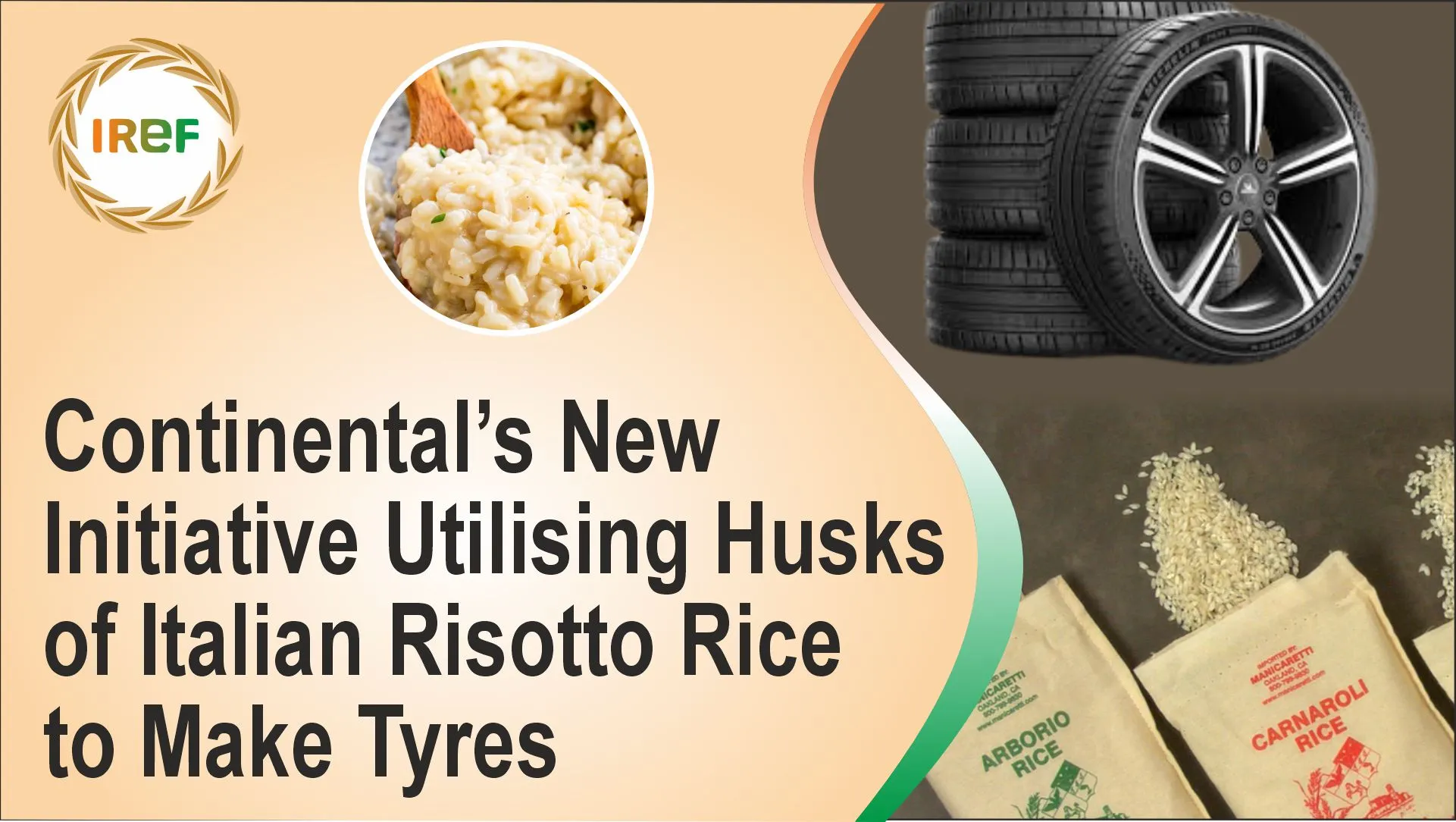
Continental, a rubber manufacturer, is increasingly using silica variants derived from the ashes of rice husks in making tyres. The company was founded in 1871 and emerged as one of the largest in the tyre business. Manufacturing around one million tyres every year, the company emphasises following a sustainable approach, including the use of renewable and recycled materials inside them.
Interestingly, the silica obtained from the ashes of Italian risotto rice is being replaced by silica from quartz sand in tyres.
Jorge Almeida, Head of Sustainability at Continental Tires, said: “Innovation and sustainability go hand in hand at Continental”. Using silica from the ashes of rice husks in our tires indicates that we are innovating something new, considering safety, quality or performance.”
Key Ingredients in the Manufacturing of Tyres
Tyres are manufactured from a composition of natural and synthetic rubbers. Not surprisingly, Natural rubber comes from rubber trees through the process of harvesting, which can absorb CO₂ during their growth, and Synthetic rubber comes from Petroleum byproducts. However, in the context of natural rubber, the augmentation of rubber plantations leads to deforestation and harms biodiversity, while synthetic rubber holds a high carbon footprint. Microplastics and nanorubber particles are released during use, which are hazardous for wildlife, human health and the environment. Carbon black is one of the main components in tyre manufacturing as it serves as a key agent in strengthening the rubber and provides strength besides the black colouring of tyres. Generally, Silica is used to enhance fuel efficiency and wet grip.
The rubber manufacturer is moving towards including sustainability in their manufacturing process. The company announced it can produce CO₂-neutral tyres at its plant in Lousado, Portugal, in May 2024. Moreover, it achieved a 26% share of these materials in 2024 and hopes this to increase to between 28-29% in 2025. Continental expects to increase this share to more than 40% while maintaining consistently high safety and performance standards till 2030. Alongside changing the materials used in its tyres, Continental is making its tyre production more sustainable. In May 2024. Earlier, Natural gas was used as the only energy source for steam generation at the plant, but this was swapped for self-generated solar power and renewable electricity from the power grid. said Dr. Bernhard Trilken, Head of Manufacturing and Logistics at Continental Tires asserted: “We are demonstrating that even very large tire plants can achieve CO₂ neutral production in Lousado”. To do so, the availability of renewable energy sources at competitive prices is pivotal. We are preparing all our plants so that we for using renewable energy as much as possible. The commissioning of our electric steam boiler in Lousado is the start of an exciting learning curve."
Silica From Rice Husks
Earlier, silica was derived from quartz sand and has been used in several tyre rubber components for decades. When it comes to rice husks, they are an agricultural derivative of rice production in the Asian agricultural industry, as well as Italian risotto rice production.
Continental asserts that the use of silica has helped to reduce braking distances by around 50%. Moreover, it also helps to reduce rolling resistance, hence reducing energy consumption and emissions. Rice husks are a good source of silica and are turned into rice husk ash on burning. Then, it is treated to remove impurities and can be further used in tyres.
What About Carbon Black
Carbon black is created out of elemental carbon in the form of fine black powder particles and produced by the incomplete combustion or thermal decomposition of hydrocarbons. Nearly a dozen types of carbon black are used in different parts of tyres by Continental.
Interestingly, Bio-based carbon black is the result of organic oil. It can also be produced using recycled raw materials, such as recycled pyrolysis oil from end-of-life tyres. Now, Continental has worked with Pyrum Innovations to optimise and intensify the recycling of end-of-life tires and is working to include more bio-based and recovered carbon black into its tyres. By using a process called thermolysis, carbon black from tires that have reached the end of their useful lives is extracted and made ready for use in the manufacture of new tyres.
Share this article
Article Info
Read Time
4 min read
Published
17 Jul 2025
Author
Megha Bajaj
Category
News