

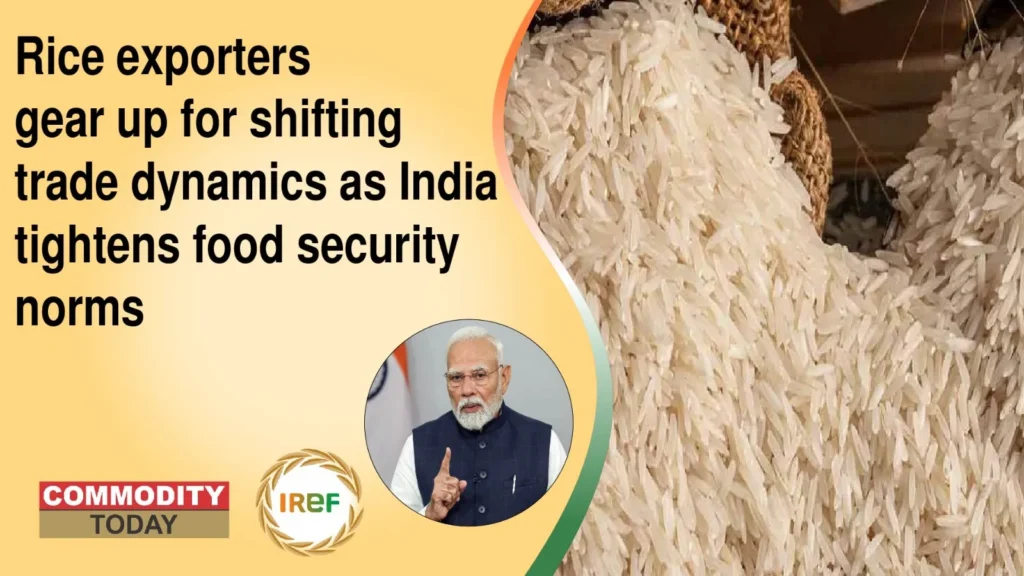
New food security measures have pushed rice export ecosystem into a new phase of change with the govt. trying to safeguard its domestic availability. According to a recent report, India exported 20.1 million tonnes of rice at the value of $12.95 billion in FY 2024–25, thereby maintaining its status as the world’s largest rice exporter and also as चावल उत्पादन में प्रथम देश. India’s export strategy, no doubt has the power to push global rice markets for trade shifts. Still, India rice exports ban, changing norms, and price controls have emerged as factors that are altering the flow of trade. In addition to these rules, rice exporters are prepping to face a more regulated, closely monitored, and demand-sensitive market.
Food Security Among Several Reasons for Govt. Concern
There are several reasons for the government’s primary concern, that includes food security, unpredictable weather, changing yields, increasing domestic consumption, and inflation concerns. Especially, irregular monsoons, heat waves have made it vital for govt. to manage the stocks in order to ensure food security for all. Apart from this, India has one of the most extensive food subsidy systems under the National Food Security Act (NFSA), which covers about 800 million people and provides grains. Hence, making sure there is enough stock for local consumption becomes not only a priority but also a challenge when the production is affected by the climate in that particular year.
To maintain the required stock, the government has taken several steps such as restrictions on non-basmati rice exports, declaration of Minimum Export Prices (MEPs) and the conducting of stricter customs checks, all aimed at the proper and adequate supply of rice in the local market.
Rice Exporters Face Uncertainty Amid Frequent Policy Changes
Frequent policy change, however, has created chaos among rice exporters. The tightening of food security rules has created uncertainty for exporters who now need to constantly adapt to new export strategy. Rice exporters are left with no options other than to adapt themselves frequently between “free,” “restricted,” and “prohibited” categories. Exporters also face challenges in managing working capital, as delays caused by compliance verification increase holding costs.
Global Importers Modify Procurement Plans
Frequent policy changes have also impacted global rice importers. The stricter Indian policies have impacted not only the country’s rice but also global procurement behaviour depending on Indian rice, particularly in the regions of West Africa, the Middle East, and South-East Asia. The sudden ban on non-basmati white and broken rice exports has led the international buyers to adopt a more diversified sourcing strategy that involves the temporary shifting of suppliers to Thailand, Vietnam, Myanmar, and Pakistan, among others. India’s moves have direct impacts on the whole world due to its enormous exporting capacity. Yet, maintaining domestic equilibrium, most importantly for the economically weaker sections, continues to be the main concern for the Indian government.
Read More News:
- Rice exporters brace for trade shifts as India tightens food security rules
- India rejects IMF Forecast that US tariffs will stay indefinitely, hit growth
- Exports to US fall: Marine, auto, jewellery find new destinations
- India Canada Trade Deal Could Guarantee Long-Term Pulse Purchases
- India sets historic record with 357 million tonnes of foodgrain production in 2025
- PM Modi Promotes GI Tagged Products As Part Of Vocal For Local Campaign
- India’s Cumin Exports Face Sharp Decline As China, Bangladesh Demand Weakens
- India, US Ink First Military Contract after Tariffs Frictions
- Stubble Burning Surges in Madhya Pradesh, Rajasthan and UP, but Drops Sharply in Punjab
- India Secures Second Position In Global Tea Exports: Govt. Unveils 1,000 Crore Support For Tea Workers