

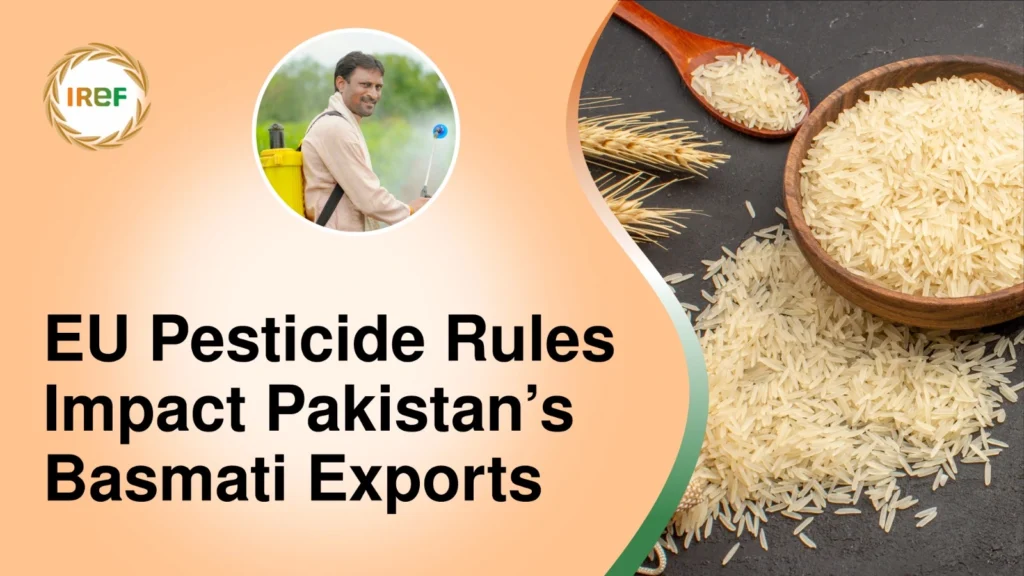
Strict MRL standards for pesticides especially in the European Union led to a major setback for the Pakistan’s Basmati exports to EU. Failing to meet the strict MRL (Minimum Residual Level) standards for pesticides last year, Pakistan suffered significant economic losses, and a loss of market share. Pakistan suffered loss due to EU’s MRL standards for certain pesticides and issues with Aflatoxin.
Again, as the Basmati crop in Punjab enters pollination stage, especially for the popular 1847 and 1509 varieties, the Pakistani rice industry is on high alert. According to the official data, Pakistan’s Basmati exports to the EU experienced a sharp decline of 41 per cent, or 74,660 tonnes, in the 12 months ending September 30, 2025. However, Indian on the right time capitalised on Pakistan’s setback and significantly expanded its own market presence. India’s share in the EU’s total brown Basmati exports jumped to 53 percent, a substantial increase from just 16 percent the previous year. Further, India’s export volume soared from 41,108 tonnes to 189,887 tonnes, reflecting a strong recovery and strategic market capture.
Seminars by Industry Stakeholders to Curb the Issue of Pakistan’s Basmati exports
In response to the crisis of decreasing Pakistan’s Basmati exports to EU, key industry stakeholders including the Rice Exporters Association of Pakistan (REAP), the Basmati Foundation, and the Trade Development Authority of Pakistan (TDAP) initiated a series of seminars and training programmes across Punjab and Sindh. These initiatives by the key stakeholders aim to educate growers on the severity of the MRL issue, its causes, and effective remedies. Post the seminar officials highlighted on the causes of decreasing Pakistan’s Basmati exports to EU and ways to overcome. The officials stressed that REAP, rice millers, and regulators need to establish vigilance committees in all Basmati-growing areas of Punjab and Sindh. These committees would monitor pesticide use to ensure compliance with international standards and prevent a repeat of last year’s export failures.
Pesticides Impacts on Human Health, Rice Export & Environment
This is not the first time the impact of pesticides has been talked about, Indian government including the state governments of Punjab and Haryana have banned the use of harmful pesticides, and strict rules have been notified on the harmful use of pesticides in India. In this context, Dr. Prem Garg, the National President of Indian Rice Exporters Federation (IREF) said that “Pesticides are negatively impacting the health of crops and humans as well”. He insisted on the complete ban of the use of pesticides. Dr. Garg further added that “use of pesticides are harmful for exports sector as well as the European Union, including other nations such as the US, Japan, Oman, Kuwait, Lebanon, and the UAE have several parameters to test the standard of Basmati Rice which is exported from India.
The national president of Indian Rice Exporters Federation (IREF) also said that Countries are repetitively rejecting basmati rice from India due to pesticide residues exceeding the prescribed MRLs of the importing country”. Dr. Garg said that “Rejection of exported basmati rice has led to a substantial loss of export business, reputational damage, and a decline in India’s market share”. However, Indian on the right time capitalised on Pakistan’s setback and significantly expanded its own market presence. India’s share in the EU’s total brown Basmati exports jumped to 53 percent, a substantial increase from just 16 percent the previous year. Further, India’s export volume soared from 41,108 tonnes to 189,887 tonnes, reflecting a strong recovery and strategic market capture. India achieved this by improving its basmati export quality and successfully meeting the parameters that importing countries set to test the standard of Basmati Rice which is exported from India.