Why Chhattisgarh Rice Mills Are Operating One Day a Week Despite Record Paddy Procurement?
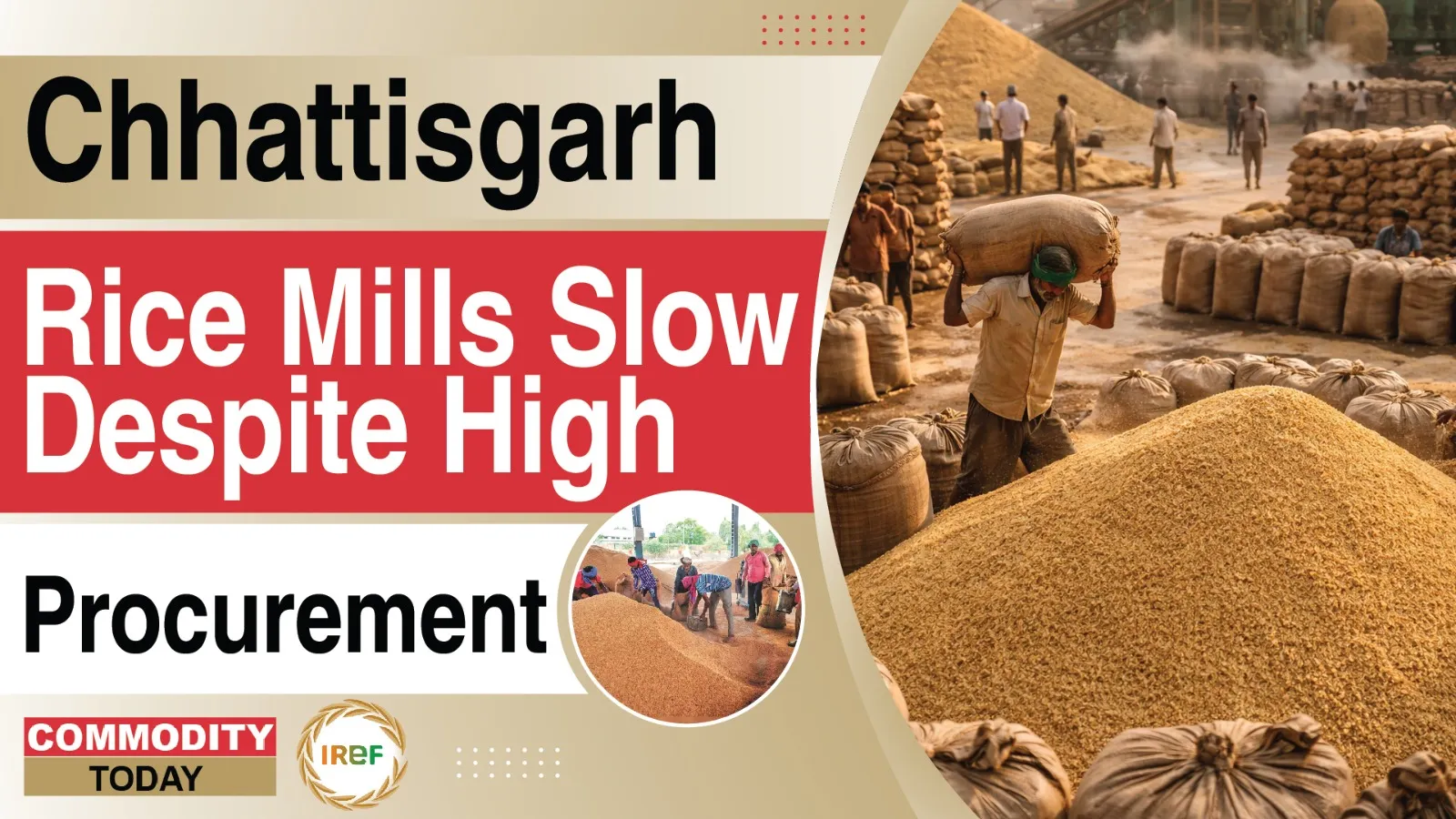
Despite the government procuring approximately 14.29 million tons of paddy during October 2025 to January 2026, a 3.7% increase from the last year, rice mills in Chhattisgarh are facing severe operational challenges. Various mills are reportedly operating only one day a week instead of six or seven, resulting in significant financial losses.
Dr. Vijay Goyal is the State Vice President of the Indian Rice Exporters Federation (IREF), Chhattisgarh, and a leading expert on Paddy procurement, milling, and trade policies. He explains that these challenges during an interview with Commodity Today, which can be seen on YouTube. According to Goyal, these challenges are not due to a lack of paddy but stem from systemic storage bottlenecks.
Chhattisgarh: The Rice Bowl of India, with Paddy procurement at 14.29 million tons
Chhattisgarh is known as the rice bowl of India, with paddy as the state’s key crop. During the Kharif season, production ranges between 14–15 million tons, while the Rabi season contributes an additional 1.5–2 million tons. Dr Goyal clarifies that the actual Paddy procurement figure stands at 14.29 million tons, correcting earlier inflated estimates.
Also Read This:
Odisha Paddy Procurement Row: Rice Millers Flag Storage Crisis, Patnaik Writes to CM
Storage Bottlenecks Crippling Mills
The core issue for rice millers is the lack of storage space, not procurement. The government currently holds around 40 million tons of surplus rice across India, including Chhattisgarh. Warehouses operated by the Food Corporation of India (FCI) and Central Warehousing Corporation (CWC) are full, creating a significant bottleneck. As a result, mills are forced to operate only 5–7 days per month, incurring heavy financial losses. Dr Goyal emphasises that rice millers are not at fault, and the solution lies in improving storage infrastructure and optimizing surplus management.
Paddy Procurement and Milling Work
Farmers sell paddy to Farmer Producer Organizations (Kisan Samitis), and the government, through Markfed in Chhattisgarh, contracts private rice millers for custom milling. For every 100 kg of paddy milled, the government demands 67 kg of rice, including 25% broken rice, to be delivered to warehouses. However, storage shortages at these facilities restrict millers’ operations, causing financial strain despite high procurement levels.
Proposed Solutions
Dr. Goyal suggests segregating paddy varieties with grain length ≥5.9 mm and allowing 33% of procured paddy to be sold directly to millers on a cash-and-carry basis with bank guarantees. This could reduce storage requirements by approximately 31% and save the government around ₹9,000 per ton. When factoring in milling and transportation costs, total savings could reach ₹16,000 per ton. Currently, milling yields only 52–55% rice, and excess broken rice is sold in the market to meet government requirements. While this system works, it adds unnecessary complexity and costs to the process. Direct sale of a portion of paddy would significantly streamline operations.
Impact on Rice Millers and Exports
Without government intervention, mills risk closure or shifting to other industries due to financial losses. Enhancing storage infrastructure and allowing direct paddy sales could revive operations, boost exports, and improve the quality of procured rice. Chhattisgarh alone contributes around 25% of India’s non-basmati rice exports, highlighting the state’s potential as a rice export hub if policy and storage challenges are addressed.
Looking Ahead
Dr. Goyal is cautiously optimistic that if the government implements these policy recommendations, including direct sale of 33% of paddy and reducing procurement mandates, the sector could see increased export potential, improved paddy quality, and reduced storage and financial burdens. Aligning the efforts of farmers, millers, traders, and government authorities is crucial to ensure smooth operations across the rice supply chain.
Conclusion
Chhattisgarh’s rice mills face operational inefficiencies despite high government Paddy procurement, primarily due to storage constraints. Policy reforms, including enhanced storage capacity and partial direct sale of paddy to millers, could ease the burden, safeguard livelihoods, and strengthen India’s position in the global rice trade.
Share this article
Article Info
Read Time
4 min read
Published
12 Feb 2026
Author
Megha Bajaj
Category
News