

Explainer: India Inks A Free Trade Agreement with Oman. Here’s All You Need to Know
December 19, 2025
Brief Intro about India-Oman Free Trade Agreement
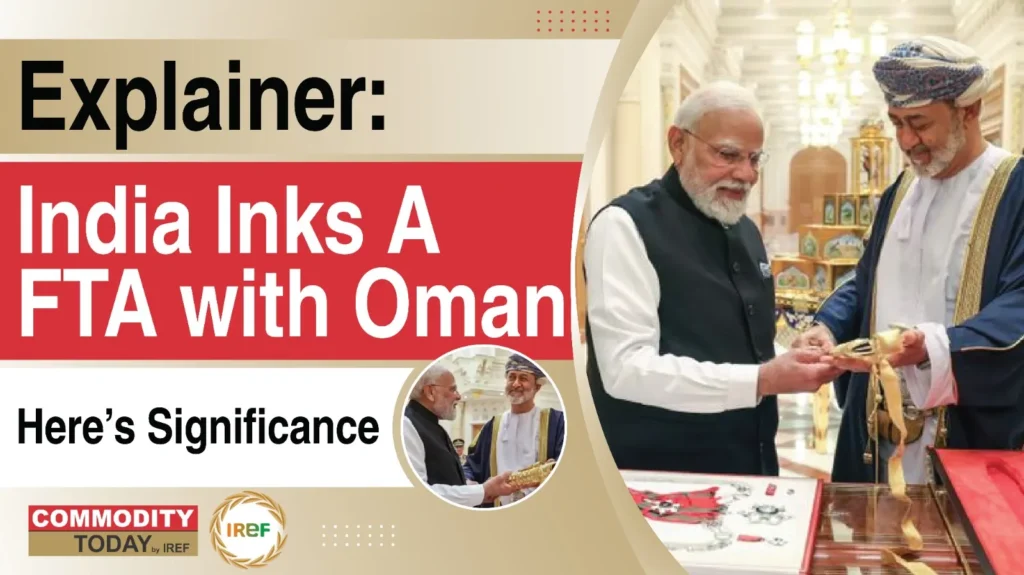
India on Thursday, December 18 signed a Free Trade Agreement with Oman. Notably, this Free Trade Agreement (FTA) is expected to significantly boost India’s economic engagement with the Gulf region and reinstate its broader trade diversification strategy. It is signed during Prime Minister Narendra Modi’s visit to the Gulf country and by Union Commerce minister Piyush Goyal and Oman’s minister of commerce, industry and investment promotion Qais Bin Mohammed Al Yousef.
Interestingly, it will be Oman’s second free-trade agreement with an individual country and its first such Agreement in nearly two decades. For India, the Comprehensive Economic Partnership Agreement (CEPA) with Oman would increase the country’s presence in the strategically significant Gulf market, playing a crucial role in energy security, remittances, logistics and regional trade flows.
What does this Free Trade Agreement do?
This Free Trade Agreement (FTA) intends to enhance market access for goods and services, promoting two-way investments and enhancing cooperation across key sectors. It will support trade diversification and supply chain resilience at a time of global economic realignment.
According to recent report by the Economic Times, under the agreement, Oman has offered zero-duty access on 98.08% of its tariff lines, covering 99.38% of India’s exports by value. This provides near-universal market access for Indian goods, especially labour-intensive sectors including textiles, leather, footwear, gems and jewellery, engineering products, plastics, furniture, agricultural products, pharmaceuticals, medical devices and automobiles. India, in return, has offered tariff liberalization on 77.79% of its tariff lines, covering 94.81% of imports from Oman by value. To protect domestic interests of domestic farmers and MSMEs, India has kept several sensitive products in the exclusion list, by not increasing any duty concessions on products in the several sectors including agricultural items like dairy, as well as chocolates, gold, silver, jewellery, footwear and sports, under the trade pact with Oman.
Beyond Goods
Services, Mobility and Investment
When it comes to services, A report by the Times of India stated that Oman has made commitments across a wide range of sectors, including computer-related services, professional and business services, audio-visual services, research and development, education and health services. Oman’s global services imports is around at $12.52 billion, with India’s share currently at 5.31%, underscoring what officials described as significant untapped potential for Indian service providers. The agreement also allows 100% foreign direct investment by Indian companies in major services sectors in Oman through commercial presence.
Mobility framework for professionals
A main highlight of the CEPA is the improved mobility framework for Indian professionals. Oman has offered wide-ranging commitments under Mode 4 (movement of skilled professionals) for the first time including raising the quota for intra-corporate transferees from 20% to 50%, and extending the permitted stay for contractual service suppliers from 90 days to two years, with the option of a further two-year extension. More liberal entry and stay conditions will apply to professionals in sectors including accountancy, taxation, architecture, medical and allied services, intend to allow deeper professional engagement.
Trade, remittances and strategic ties
India-Oman bilateral trade was at about $10.5 billion in 2024-25, with exports of $4 billion and imports of $6.54 billion. Oman is India’s third-largest export destination among GCC (Gulf Cooperation Council) countries. Around 7 lakh Indian nationals live in Oman, and India receives around $2 billion in remittances annually from the country. Nearly 6,000 Indian establishments operate in Oman, and India has received $615.54 million in FDI from Oman between April 2000 and September 2025.
What is significance of this Free Trade Agreement?
Economic Boost
The agreement gives India near-universal duty-free access to the Omani market, helping exporters compete better and expand sales amid global uncertainties, according to a report by the times of India.
Moreover, another report by Moneycontrol mentioned that it is expected to significantly boost Indian exports, especially in sectors including textiles, chemicals and engineering and could add billions toexport value within a few years.
Strategic and Diplomatic Significance
A latest report by News 18 mentioned that this CEPA with Oman fits into this broader framework, underscoring India’s push to build a diversified and resilient trade market through mutually beneficial partnerships. With the Gulf emerging as a key node in global supply chains and investment flows, the agreement is expected to further anchor India’s economic and strategic ties with the region of GCC countries.
India’s Free Trade Agreements with other countries
In the past couple of years, India has broadened its network of trade agreements. In 2025, India signed a Free Trade Agreement (FTA) with the United Kingdom that comprised of decreasing tariffs on nearly 90 per cent of traded goods and expected to boost bilateral trade. In 2024, India sealed a Trade and Economic Partnership Agreement with the European Free Trade Association (EFTA) bloc consisting Switzerland, Norway, Iceland and Liechtenstein. It supported strong investment commitments to the Indian economy.
Not only this, but India also inked an Economic Cooperation and Trade Agreement (ECTA) with Australia in 2022. This Economic Cooperation and Trade Agreement (ECTA) discarding tariffs on most traded goods and generating new export opportunities for Indian products. In addition, India sealed a Comprehensive Economic Partnership Agreement (CEPA) with the United Arab Emirates, eliminating tariffs on nearly 90 per cent of Indian exports and offering a major push to sectors including gems and jewellery, textiles, leather and engineering goods. Besides this, in 2021, India inked its first Africa-focused trade agreement with Mauritius, that intended to enhance market access and positioning the island nation as a gateway for Indian businesses into African markets.
Conclusion
India–Oman FTA is a timely and strategic trade agreement that boosts economic ties, opens new market opportunities and enhances India’s presence in the Gulf, provided its benefits are effectively realised across the sectors.