


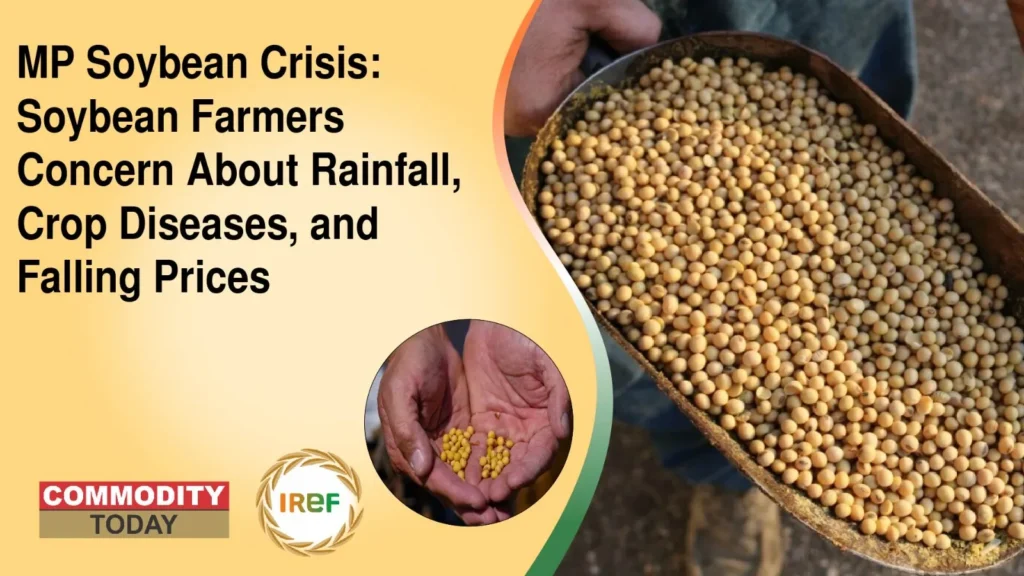
Madhya Pradesh is the country’s largest soybean producing state but currently Soybean farmers in the state have been hit hard by a double whammy: heavy rainfall have ruined their crops, and failing to receive fair prices for their produce has brought tears to their eyes. Although the state government has launched a Bhavantar Yojana to ensure farmers’ prices as well as voices of protest are being heard against it. Small farmers are unable to fully benefit from this scheme. AOm Soybean Farmers complain that this soybean season has witnessed the traders becoming wealthy, whereas farmers are left in dire straits. Soybean is cultivated extensively in the Malwa region of Madhya Pradesh, with Dhar and Khargone districts being the significant ones. This time, farmers grew soybean crops with great expectations and diligent care, but the weather was not favorable since the yellow mosaic disease affected the soybeans, and there was also an infestation of caterpillars.
MP Soybean Crisis: Lack of Rainfall raised concerns of Soybean farmers
Soybean Farmers report that rain didn’t arrive on time. Even if it did, it was very little. This led to a water shortage for the crop. This shortage worsened the impact of yellow mosaic disease on the crop. Not only this, the heavy rainfall also decreased in flowering, resulting in a decline in soybean production. In some places, it rained during harvesting, leading to a significant drop in yield. While farmers typically yield 17-18 quintals of soybean per hectare, this time they averaged only 3-5 quintals per hectare. This illustrates the extent of the farmers’ devastation.
Soybean Farmers set crops on Fire
In Khargone, farmers reportedly set their standing crops on fire with matches. They were so disheartened that they didn’t even consider it worth the effort to harvest. They felt that the money spent on harvesting wouldn’t even be worth the cost of selling the crop, and transportation would be an additional cost. Fearing this, farmers set their crops on fire in the fields. After talking to the farmers, they learned that the produce, which was of poor quality, was fetching a maximum price of Rs 2,900 per quintal. The farmers then decided to set it on fire.
Meanwhile, the Bharatiya Kisan Sangh (BKU) demanded that farmers receive compensation under the Prime Minister’s Crop Insurance Scheme or receive relief funds from the administration. However, this was not implemented. Even crop assessments were not conducted, as a survey cannot be conducted unless the entire district’s crop is damaged. No one visited the fields to see the farmers’ ruined crops. Regarding this, Sadashiv Patidar, District President of the Bharatiya Kisan Sangh, Khargone, said that the government’s Bhavantar Yojana (Bhaavantar Yojana) initiative is a good thing. Farmers had high hopes for it. However, its FAQs have caused disappointment among farmers. Under the FAQs, the government imposed conditions on the Bhavantar Yojana that are beyond everyone’s reach. Farmers’ entire crops are not good enough to meet the government’s standards. This has had the worst impact on small farmers, whose crops are of low quality. Their crops are not benefiting from the Bhavantar Yojana.
Read More News:
- MP Soybean Crisis: Soybean Farmers Concern About Rainfall, Crop Diseases, and Falling Prices
- US Tariffs Relaxations Paves The Way For India’s Agricultural Trade
- India Appeals To The UAE To Follow Quota System For Gold Exports
- FAO Releases Report on Global Food Production Outlook
- Rubber Board Launches 6th Edition Of Virtual Trade Fair To Boost Rubber Exports
- 31 High-Impact IRRI-NARES-Developed Rice Varieties Now Available Across India
- Cabinet Approves Rs. 7,280 Crore Rare Earths Scheme Amid China’s Export Controls
- Madhya Pradesh leads in farm stubble burning for the second consecutive year
- Exports Grow in Positive Zone; SEZ Surplus Could Reduce India’s Imports, says Piyush Goyal
- Heaviest Rains in 300 Years Trigger Widespread Flood Disaster Across Southeast Asia