

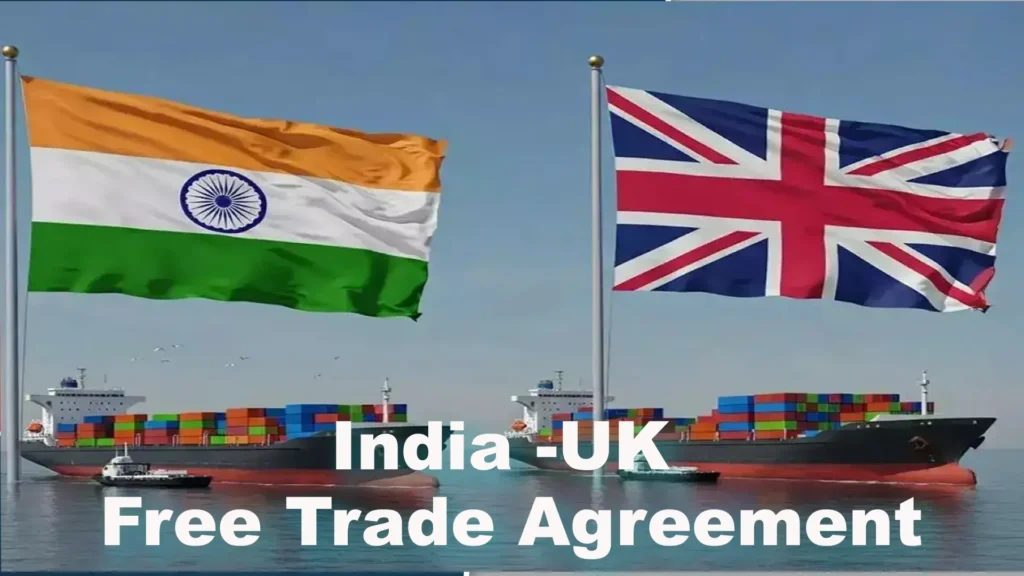
The Govt. of India and the UK negotiated a Free Trade Agreement (FTA) between the United Kingdom and India. This Comprehensive Economic and Trade Agreement (CETA) aims at reducing the tariffs imposed on businesses making it easier to trade. The UK’s gross domestic product (GDP) is estimated to increase by 0.13%, equivalent to £4.8 billion, and India’s GDP by 0.06%, equivalent to £5.1 billion per year in the long run. The UK-India trade deal is a major boost for Indian Basmati Rice Exporters involved in rice exports to the United Kingdom.
The bilateral trade is hailed as the game-changer by experts and govt. officials as the Comprehensive Economic and Trade Agreement (CETA) will significantly expand market access & is poised to boost the profitability of Indian Basmati Rice in the United Kingdom including the popular 1121 and Pusa 1401 rice variety which is mainly grown in Punjab, Haryana, and Madhya Pradesh.
What is an FTA? (Free Trade Agreement Meaning)
A Free Trade Agreement (FTA) is a treaty between two or more countries that is aimed at reducing or eliminating trade barriers, such as tariffs and quotas on goods and services traded between them. These days, FTA is in news because India and UK have signed the Comprehensive Economic and Trade Agreement (CETA), a deal that will boost bilateral trade.
This deal is hailed as a landmark deal for rice exporters association as it will directly benefit basmati rice exporters and help them expand their market in the United Kingdom. The Free Trade Deal was signed in the presence of Narendra Modi and his counterpart Keir Starmer. India UK FTA is a big win for Indian Agriculture sector as UK markets are now open duty free for almost all agri exports with few exceptions.
India-UK Trade Deal: A win -win situation for Basmati Rice Exporters
The bilateral trade between India – United Kingdom is a win-win situation for basmati rice exporters as it has now removed customs duties on brown Basmati rice entering the UK. With the elimination of custom duties, the export of Indian Basmati Rice to UK is poised to touch the whooping figure of 2.5 lakh MT from the current 1.85 lakh metric tonnes (MT).
For the unversed the UK imports approximately 3 lakh MT of Basmati rice every year. India’s current share in the UK rice market is approximately 55% which is also set to expand after this pact.
A Promising Future for Farmers and Rural Economies
India- UK FTA has not only opened the door for exporters but also for Indian farmers especially in prominent Basmati producing states like Punjab, Haryana, & Uttarakhand. Following the CETA the demand for Indian Basmati Rice in the UK market will increase translating the demand into better prices for Indian farmers.
It will also boost rural economies creating job opportunities and will strengthen Micro, Small & Medium Enterprises (MSME) involved in the value chain of Basmati Rice.
Boost to Make in India Vision on the Global Stage
India-UK FTA is a promising deal for Indian exporters as it is expected to strengthen country’s presence in premium markets like the UK and will significantly boost ‘Make in India’ and ‘Vocal for Local’ vision on the global stage. The agreement is expected to reshape the agricultural landscape while boosting the rural economies and paving the way for MSMEs.
Challenges Amidst India-United Kingdom Comprehensive Economic and Trade Agreement
Though CETA brings a significant opportunity for exporters, there are some challenges that need to be addressed to ensure long-term success of the agreement. The most prominent concern is the concern about the pesticide residue levels in Indian Basmati rice. Though the Indian Government has already taken steps to overcome this like the ban of harmful pesticides in Punjab still there are areas where Indian govt. needs to act wisely to raise awareness among farmers. FTA has also established a subcommittee on sanitary and phytosanitary (SPS) to balance the need for health and safety regulations with the goal of facilitating free trade.
CETA has also excluded semi-milled or wholly milled Basmati rice (HSN Code 1006:30) from the duty-free list, that means this category of rice still attracts import duties. CETA has excluded rice with HSN (HSN Code 1006:30) whereas included rice with HSN (HSN Code 1006: 20).
Key Takeaways of Free Trade Agreement Between India and UK
- India and the UK have signed CETA, a landmark deal to strengthen economic ties and boost bilateral trade.
- The agreement eliminates tariffs on 99% of India’s exports to the UK, covering nearly 100% of the trade value.
- Tariffs on basmati rice, marine products, textiles, leather, and processed foods have been reduced from up to 70% to zero.
- A big win for Indian Agriculture as UK markets open duty free for nearly all Indian Agri exports, with limited exceptions
- Services commitments cover IT, financial, education, healthcare, and other high-value sectors.
- Mobility provisions simplify entry for business visitors, professionals, and intra corporate transferees.
- UK will allow 1,800 Indian chefs, yoga instructors, and artists contractual service quotas. annually under
- The Double Contribution Convention will save Indian companies and workers over *4,000 crore by removing dual social security payments.
- Consumers will benefit from wider product choice, lower prices, and strong digital trade protections.
- Punjab is expected to be among the biggest beneficiaries of the India-UK deal, as the state contributes nearly 40% of the total Basmati rice produce of the country and played a major role in India’s Basmati exports worth Rs 48,000 crore in 2022 as per APEDA.
- Nearly 95 per cent of India’s agricultural exports to the UK—including Basmati rice, millets, cotton, groundnuts, fruits, vegetables, onions, spices, pickles, tea, and coffee—will now be duty-free