

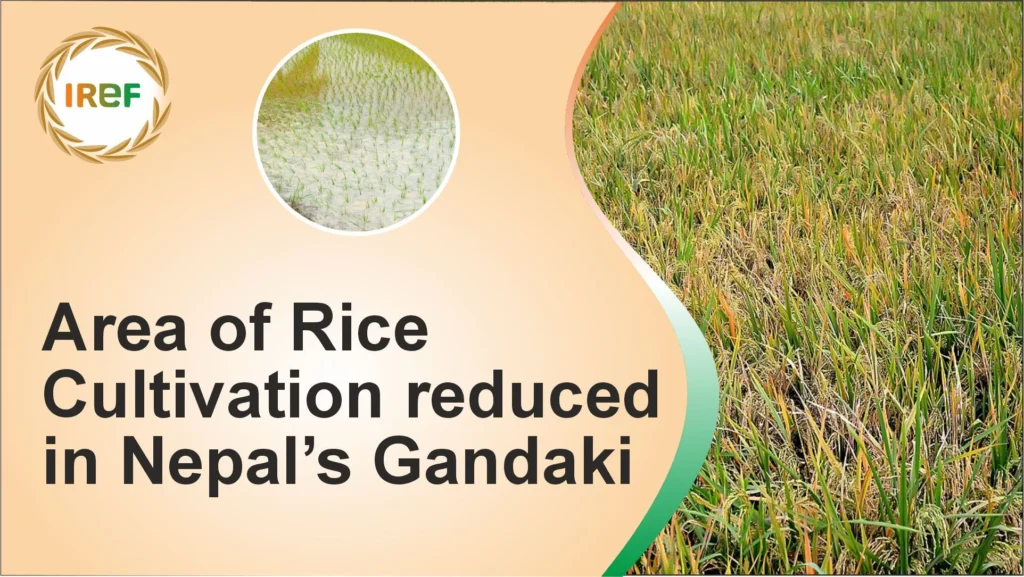
The rice cultivation area in the Gandaki Province of Nepal has been reducing over the years due to increasing urbanisation, land plotting, and massive infrastructure development that have turned into the loss of arable land.
As per data reported by Ministry of Agriculture Land Management and Cooperatives of Gandaki Province, the land used for rice production in the province has been gradually reducing. However, rice was cultivated on 97,679 hectares in the Fiscal Year 2022/23, this figure fell to 96,053 hectares in 2023/24. Notably, the Ministry estimates that paddy plantation will be conducted on 94,182 hectares this year.
Not only this, It reported that Gandaki cultivates numerous rice varieties such as Sabitri, Ram Dhan, Hybrid, Jetho Budho, Jhinuwa, Ekle, Gurja, Pahenle, Champion, Makwanpur, Aapjhutte, Manisara, Mansuli, Anadi, Kalo Masino, US, Maharaja, Holasy, Bahubudi, Hardinath, Gurdi, Khumal, Gauriya, Biramphool, Pokhareli Jetho Budho, Lumle, Machhapuchhre, Jarneli, and Sugandha.
According to Jyoti Kshetri, Information Officer of the Ministry, plantation has been conducted on 66,900 hectares across the province till now. Further, adding that around 70% of the total paddy plantation had been conducted in Nepal’s Gandaki. Moreover, Rice is not cultivated in in Manang and Mustang out of 11 districts in the province. Interestingly, Nawalpur holds largest area for rice cultivation in the Gandaki at 14,111 hectares, but only 75.39 per cent of plantation has been completed over there till now.
Likewise, only 65.69 per cent of plantation has been completed in Myagdi since it lies in the Himalayan region, plantation has been carried out on just 2,500 hectares. The plantation data has been recorded lower in other districts such as Baglun with 67.02 per cent, Syangja with 62 per cent, around 60 per cent of Parbat, 77.07 per cent of Kaski, Tanahun with 74.59 per cent, and nearly 61.24 per cent of Kaski
Furthermore, Kshetri, Information Officer of the Ministry stated that nearly 250,000 tonnes of rice is predicted to be produced in Gandaki this year. There is land suitable for rice farming, yet several factors are affecting significant areas have remained unused due to several factors that has ultimately unused affecting overall production.