BHU's MMSD: An Innovative High-Yield Rice Variety for Indian Agriculture
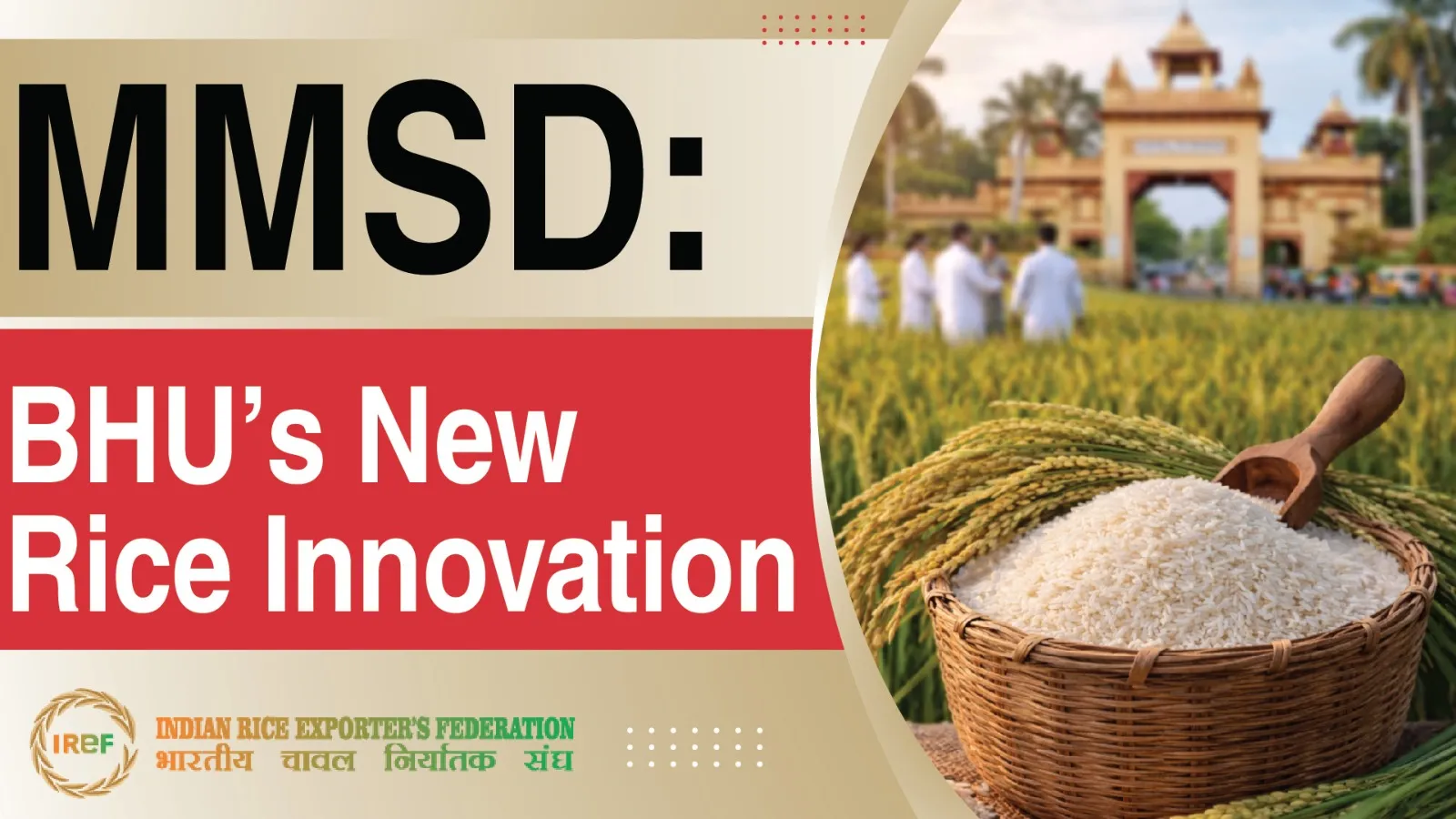
Amid the Middle East War that has impacted the India’s rice exports, Banaras Hindu University (BHU), the institution has taken a pivotal step toward agricultural innovation in India by licensing its newly developed rice variety, naming MMSD, to Trimurti Plant Sciences Pvt. Ltd., Hyderabad. Notably, the licensing agreement was finalized during a formal ceremony. Interestingly, the MMSD rice variety was developed over 18 years of research in collaboration with the International Rice Research Institute (IRRI) in Manila, Philippines. It is renowned for its adaptability and impressive high-yield rice variety potential.
Traits of MMSD
According to reports, this rice variety delivers excellent yields regardless deployment of sowing method. The report stated that the MMSD rice variety can produce a yield of 55 to 64 quintals per hectare just 115 to 120 days, highlighting its strength as a short-duration rice crop. Furthermore, it is noted that this rice variety is particularly capable of delivering strong performance, especially in terms of yield, in the states such as Uttar Pradesh, Bihar, and Odisha. With an amylose content of 26.30 percent, this rice variety also falls under easy-to-cook rice varieties.
MMSD’s exquisite flavor despite slight stickness
Although this rice exhibits a slight stickiness after cooking, its flavor is described as exquisite, moreover, its long, slender grain structure makes it an excellent choice for preparing dishes like biryani and Pulao rice. A standout feature of this rice variety is its high head rice recovery rate of 63.50 per cent, which is highly advantageous for grain processing operations. Notably, this early-maturing rice variety has gained traction among farmers for its ability to support intensive cropping systems. By virtue of its rapid maturation cycle, this rice variety holds the potential to play a pivotal role in boosting farmers' incomes. Experts noted that MMSD is a short-duration crop variety, allowing farmers the opportunity to cultivate crop sequences such as green pea–wheat–summer mung, rice–green pea–mustard–summer mung, and potato–mung, which can significantly boost their income.
Consequently, the early harvesting of this rice variety facilitates the timely sowing of the subsequent crop, thereby leading to improved overall yields. In the context of plant morphology of this paddy variety, it is semi-dwarf rice variety in nature, typically reaching a height of approximately 105–110 cm. Its stems are robust, remaining largely upright even during windy conditions, which minimizes the risk of crop damage. Furthermore, this rice variety demonstrates a fair degree of resistance against various diseases and pests, including leaf blast, brown spot, stem borers, and leaf folders. These are some of the distinct characteristics of the rice variety instill a sense of confidence and trust among farmers.
Licensing of the MMSD – hailed for Agri Innovation
The licensing of the MMSD rice variety to Trimurti Plant Sciences Pvt. Ltd., Hyderabad, is being hailed as a particularly significant development from the perspective of agricultural innovation in India. In addition, the cultivation of this paddy variety by farmers is expected to enhance their incomes, and there appear to be promising prospects for its rice exports from India to international markets. Notably, rice cultivation in India has been witnessing continuous growth. Recently, Bhagirath Choudhary, the Union Minister of State for Agriculture and Farmers Welfare, informed the Rajya Sabha that the country has observed a substantial increase in rice production, with the total output for the year 2024–25 projected to reach 150.18 million tonnes. According to the data provided by him, this projected rice output represents an increase of approximately 12.36 million tonnes over the last year's production of 137.83 million tonnes.
The government has stated in Parliament that the increase in food grain production in India is attributable to the hard work of farmers and the adoption of new technologies. Additionally, the primary drivers behind this growth in production are the expansion of the area under cultivation and improvements in agricultural productivity. Furthermore, the development of climate-resilient, high-yielding varieties, along with cost-effective pre- and post-harvest technologies, has played a crucial role in this regard. In terms of the rice trade, India currently stands as both the world's largest rice producer and its largest exporter. The country possesses a rice surplus. Moreover, it holds a 40 percent share of the global rice trade. Farmers are receiving a better Minimum Support Price (MSP) for their rice. Consequently, the combination of favorable pricing and conducive weather conditions has contributed to sustaining both the continuity and the improved levels of rice production in India.
Share this article
Article Info
Read Time
4 min read
Published
17 Mar 2026
Author
Megha Bajaj
Category
News