Vietnam’s Rice Export Paradox in 2025: High Volumes, Falling Prices and Rising Competition
Vietnam’s Rice Export Paradox in 2025: High Volumes, Falling Prices and Rising Competition
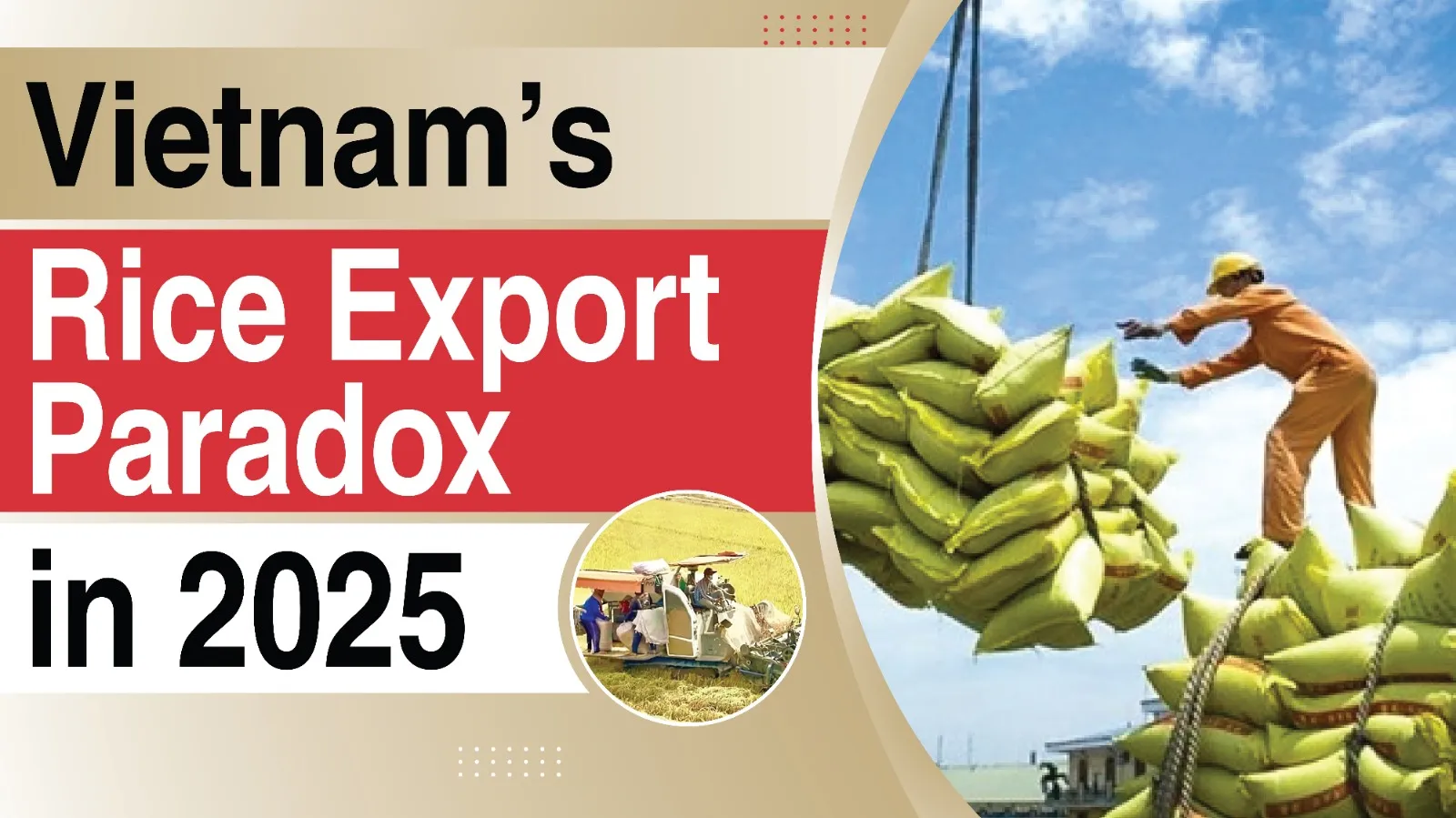
In 2025, Vietnam played a significant role in rice exports. According to the Vietnam Customs Department, the country exported over 8.06 million tons of rice during 2025, generating approximately US$4.1 billion in foreign exchange. However, these figures also show some weaknesses compared to the previous year. The volume of rice exports in 2025 reduced by 10.8 per cent compared to 2024, whereas the export value witnessed an even steeper decline of approximately 27.6 per cent.
Philippines-largest rice importer, is buying 40% of Vietnam’s total rice exports
When it comes to buyer countries, the Philippines remained Vietnam's largest rice importer, purchasing nearly 40 per cent of Vietnam's total rice exports, amounting to over 3.2 million tons. However, the last month of the year, December 2025, observes a surge in rice exports. Interestingly, Vietnam exported 522,387 tons of rice, an increase of approximately 39.6 per cent compared to November 2025. Concludingly, this rice export data reflects Vietnam's strong rice production capacity. Vietnam is among the world's leading rice exporters. Total rice exports in 2025 exceeded 8 million tons, although this figure is lower than the nearly 9 million tons exported in the previous year, 2024.
The main reasons for this decline were lower global rice prices and weaker demand in international markets. A clear decline in global rice prices was observed; for example, the price of 5 per cent broken rice fell to between US$360 and US$365 per ton. This price drop directly impacted Vietnam's total export revenue. Now, when it comes to demand, rice purchases from the Philippines decreased by approximately 24 per cent. This shortfall proved to be a major blow for Vietnam, as the Philippines has been its largest buyer. However, some relief was provided by rice markets such as China, African countries, and Bangladesh. Earlier estimates had projected exports of up to 8.8 million tons for 2025, but the actual figures fell short of these projections, signalling to a global supply surplus and intensifying competition.
Vietnam as world’s second-largest rice exporter
The rigid challenge from countries including India and Thailand, in particular, was a significant factor for Vietnam. Despite this, Vietnam achieved its goal of becoming the world's second-largest rice exporter, surpassing Thailand. However, it could not fully capitalise on this achievement due to falling prices. This rice export is extremely significant for Vietnam's economy. The agricultural sector contributes a significant portion to Vietnam's Gross Domestic Product (GDP) and employs millions of farmers. However, the 27.6 percent decline in export revenue could directly impact farmers' incomes. This is likely to increase pressure on the rural economy. Globally, this situation maintains a kind of stability in the rice market. But, falling rice prices could intensify competition for other rice-exporting countries, especially countries such as India, which was exporting over 11 million tons of rice in 2025. For importing countries, the availability of cheaper rice in markets such as the Philippines is a positive sign in terms of food security. However, this situation could become a long-term challenge for Vietnam if global demand remains weak. Furthermore, when it comes to environmental impacts, factors such as climate change and water scarcity could affect future rice production. Overall, this situation may encourage Vietnam to focus more on producing high-quality rice, such as organic or speciality varieties, to increase export value. Vietnam's rice exports in 2025 are a significant achievement in themselves. Despite the global economic downturn and falling rice prices, exporting over 8 million tons demonstrates Vietnam's strong production capacity. However, the sharp decline in export earnings is a cause of concern. This situation indicates that relying solely on volume will not be sufficient in the long run. The focus now needs to shift to value addition and market diversification. Vietnam should leverage free trade agreements, such as the one with Israel, to explore new markets. Simultaneously, adopting sustainable agricultural practices is crucial to effectively address climate risks.
Share this article
Article Info
Read Time
4 min read
Published
14 Jan 2026
Author
Megha Bajaj
Category
News