Union Budget 2026 Lays the Foundation, More Sector-Specific Reforms Expected Soon: Dr Prem Garg, NP, IREF

Union Budget 2026 Lays the Foundation, More Sector-Specific Reforms Expected Soon: Dr Prem Garg, NP, IREF
By Megha Bajaj
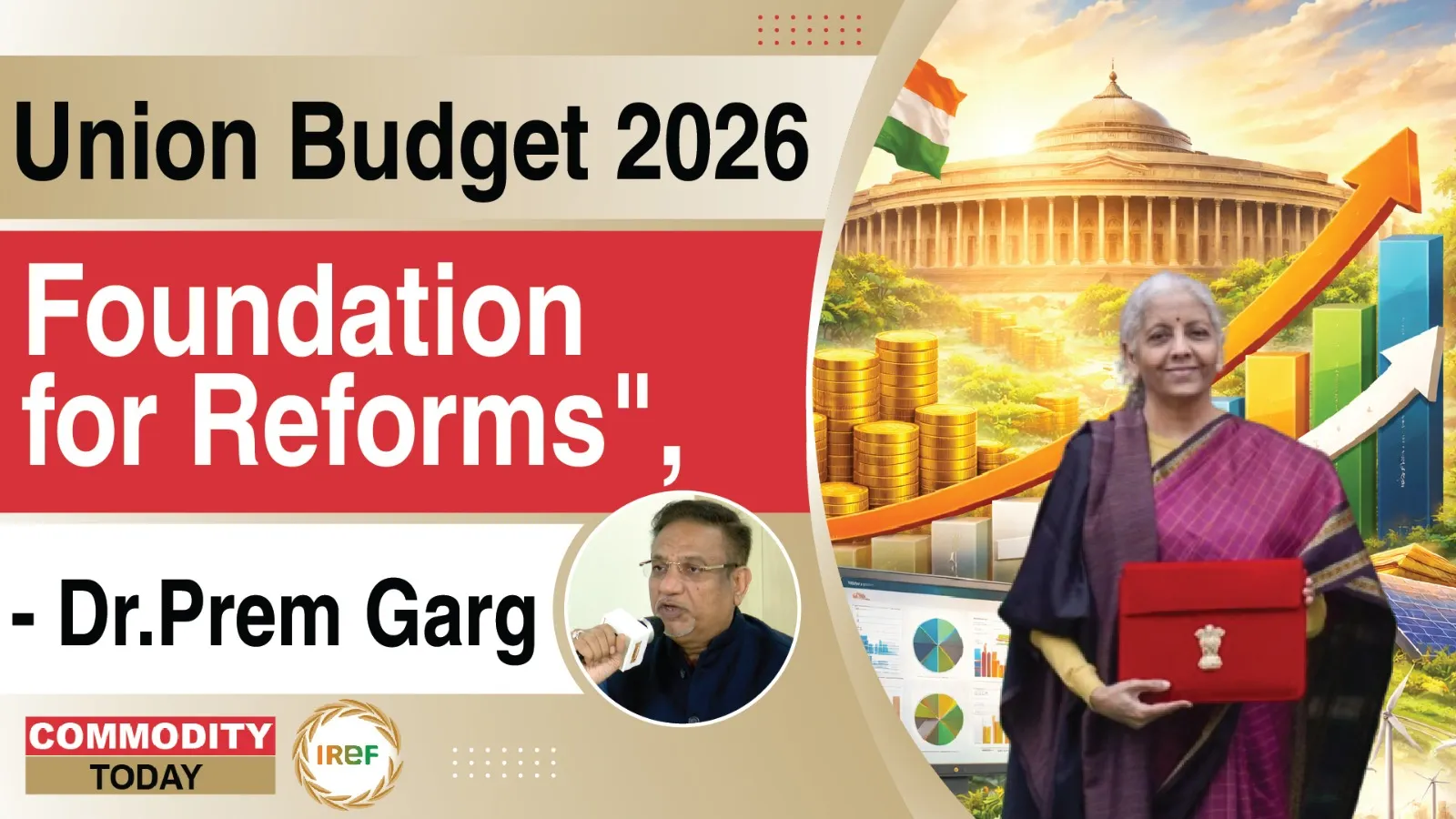
Responding to the Union Budget 2026 presented by Finance Minister Nirmala Sitharaman on Feb 1, 2026, Dr Prem Garg, National President of the Indian Rice Exporters Federation (IREF), called the budget a starting point for a larger reform journey, while noting that its unusually short duration limited detailed sector-wise announcements.
Union Budget 2026, One of the Shortest in Recent Years
Dr Garg mentioned that this was the Finance Minister’s ninth budget and one of the shortest in recent years, lasting just about an hour compared to the usual 1.5 hours or more. “Because of the brief presentation, several sectors and schemes could not be discussed in depth. Some previously announced reforms, including proposals involving benefits up to ₹50 lakh, were cited but not elaborated upon. We expect more clarity and expansion in the coming months,” he said.
Commenting on the market response of Union Budget 2026, Dr. Garg observed that the stock market initially witnessed a sharp decline of nearly 2,500 points, followed by a recovery of around 1,000 points. He attributed this volatility to the government’s calibrated approach to reforms. “The government appears to be following a phased reform strategy, where changes will be introduced gradually rather than announced all at once in the budget speech. This allows markets and industries time to adapt,” he noted, expressing optimism about further recovery.
IREF proposed enhanced Export benefits to the Finance Ministry
Focusing on the rice export sector, Dr. Garg stated that IREF has proposed enhanced export benefits to the Finance Ministry, particularly in shipping subsidies. Currently, rice exporters receive a subsidy of around 1%, which the federation has recommended be increased to 3%. “India exports rice to nearly 172 countries. With improved subsidies, export growth could increase from the current 40% to nearly 60%, significantly benefiting Indian exporters, especially MSMEs operating on thin margins,” he explained.
Dr. Garg also raised concerns about persistent banking challenges faced by MSMEs and small exporters. He pointed out that restrictive procedures, high compliance burdens, and steep charges for Letter of Credit (LC) transactions continue to hinder growth. “Banks charge around 20 to 30 paise per rupee on LC payments, which is extremely burdensome for small exporters and startups. We have suggested capping these charges at 2 paise per rupee and standardizing them for all exporters, irrespective of size,” he said.
Emphasizing the need for equitable treatment, Dr. Garg stated that benefits extended to large exporters should also be made available to small and medium exporters and startups. “Equal access to financial and policy support will remove entry barriers and enable smaller players to compete effectively, boosting India’s overall export ecosystem,” he added.
Looking ahead, Dr. Garg said that IREF plans to formally approach the Finance Ministry, the Government of India, and the Prime Minister with additional recommendations not covered in the current budget. Referring to India’s status as the world’s third-largest economy, he said, “If India is to realize the Prime Minister’s vision of becoming the number one economy by 2047, continuous reforms and periodic policy support are essential. This budget should be seen as the foundation, not the final step.”
On agriculture, Dr. Garg acknowledged that while the budget includes some positive provisions, there remains substantial scope for further reforms and incentives. “Agriculture and agri-exports have immense potential. We are optimistic that the government will soon announce more targeted reforms to support farmers, exporters, and the broader agricultural economy,” he concluded.
Share this article
Article Info
Read Time
3 min read
Published
2 Feb 2026
Author
Megha Bajaj
Category
News