India Unlikely to Impose Immediate Rice Export Curbs in Next Month, IREF Says; Policy Risks Remain
25 November 2026 | Indian Rice Exporters’ Federation (IREF)
Exporters can continue shipments under the prevailing policy framework, but rising domestic prices could trigger a review of export duties or other restrictions, the industry body says.
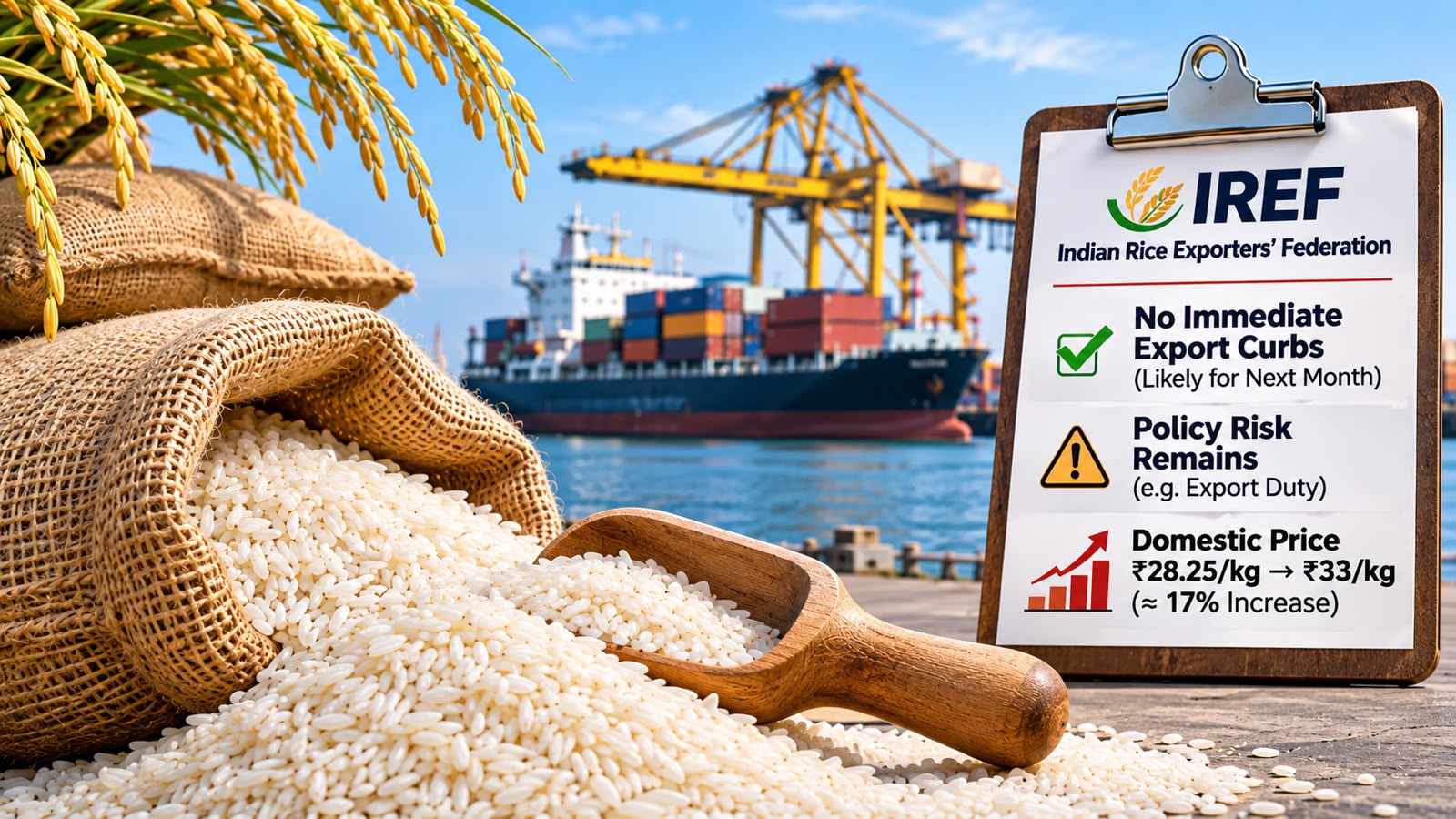
India is unlikely to impose immediate restrictions on non-basmati rice exports over the next month, according to the Indian Rice Exporters’ Federation (IREF), offering some relief to exporters amid growing concerns over possible government intervention in the rice trade.
Based on information received from sources familiar with policy discussions, IREF’s current assessment is that reports suggesting export restrictions could be introduced within the next few days appear premature. While policy options remain under consideration, there is presently no indication of an immediate move to curb exports.
Exporters can therefore continue operations under the prevailing policy framework. However, IREF has cautioned that the possibility of export duties or other policy measures cannot be ruled out, particularly if domestic rice prices continue to rise.
Rising Domestic Prices Keep Policy Risks Alive
Domestic non-basmati rice prices have come under pressure over the past month. According to market inputs received by IREF, the price of IR-64 25% broken white rice has increased to approximately ₹33 per kg, compared with ₹28.25 per kg a month ago, marking a rise of nearly 17%.
The sharp increase has brought non-basmati rice exports under closer scrutiny, as the government remains attentive to domestic food-price stability and availability.
India’s substantial rice stocks provide an important cushion for domestic supply. The Public Distribution System (PDS), through which eligible households receive subsidised or free foodgrains under their entitlements, also helps protect beneficiaries from fluctuations in open-market prices.
However, strong international demand continues to influence domestic market dynamics. A further significant increase in domestic prices could prompt a review by the Committee of Ministers, potentially leading to consideration of export duties or other appropriate policy measures.
For exporters, the immediate outlook is therefore relatively reassuring, but the broader policy uncertainty remains.
IREF Advises Exporters to Strengthen Contractual Safeguards
In view of the prevailing uncertainty, IREF has advised exporters to continue business with appropriate contractual and inventory safeguards.
The federation has highlighted three key areas requiring attention:
1. Clearly Allocate Potential Export-Duty Costs
New export contracts should expressly specify that any new or increased Indian export duty applicable to the shipment will be borne by the buyer. Exporters should obtain written acceptance of this provision and establish a clear mechanism for price adjustments and payments.
2. Review Contractual Protection Against Policy Changes
Exporters should incorporate appropriately drafted change-in-law provisions and review force majeure clauses to address possible government restrictions or changes in export policy. Contracts should clearly define the circumstances under which shipments may be suspended, renegotiated or cancelled.
IREF has also advised exporters to inform overseas buyers about the possibility of additional duties or restrictions before finalising contracts. Potential duty increases should be specifically addressed rather than relying solely on standard force majeure provisions.
3. Avoid Excessive Inventory and Unprotected Commitments
Exporters should align inventory levels with confirmed orders, realistic shipment schedules and their ability to manage potential policy changes. Excessive or speculative stock accumulation could increase commercial exposure if export duties or restrictions are introduced.
Long-duration, fixed-price contracts without adequate provisions for policy-related costs should be approached with particular caution. Exporters are also encouraged to review existing contracts and mutually agree on written amendments wherever necessary.
Exporters Urged to Remain Alert to Policy Developments
IREF’s assessment provides some near-term reassurance to the non-basmati rice export industry, but it does not eliminate the possibility of future policy intervention.
The outlook will depend significantly on domestic price movements, food-supply considerations and the government’s assessment of market conditions.
The federation has urged exporters to continue their business activities under the existing policy framework while maintaining close communication with overseas buyers, monitoring official government notifications and managing contractual and inventory exposure prudently.
IREF’s assessment is based on information presently available to the federation and may change in response to market developments or government decisions. It should not be interpreted as an official government assurance on future export policy.
Share this article
Article Info
Read Time
4 min read
Published
25 Nov 2026
Category
News