Explainer: What Makes Delhi’s AQI So Toxic?
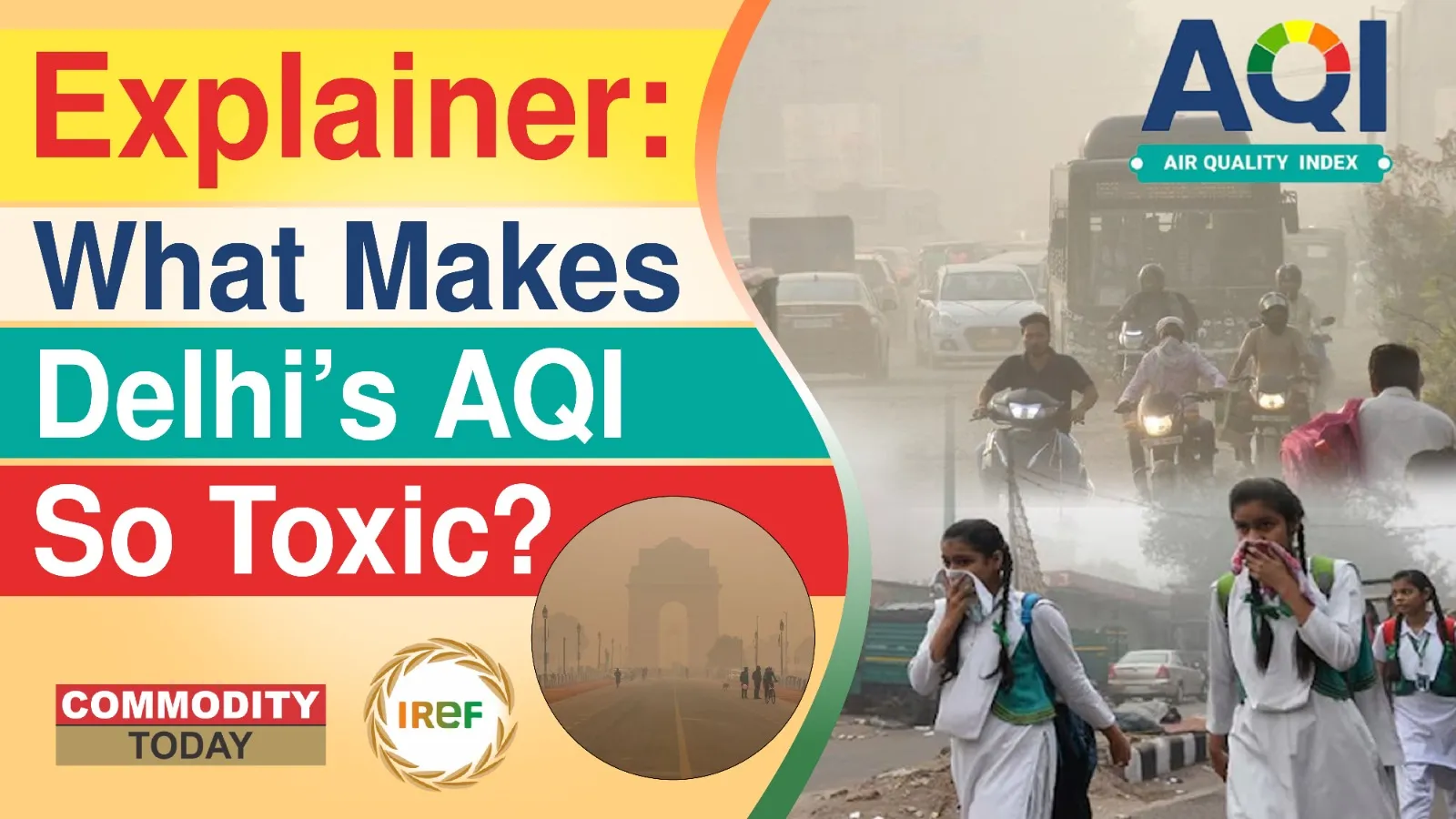
What Is AQI , And Why Does Delhi’s Air Quality Matter?
Air pollution is usually measured using the Air Quality Index (AQI), which is a standardized way to express how polluted the air currently is or is forecast to be. Air Quality Index (AQI) gathers data on key pollutants such as PM2.5, PM10, NO₂, etc. into a single number, which is further given to categories like Good, Moderate, Poor, Very Poor, or Severe. For people living in a densely populated, heavily industrialized, and traffic-intense city like Delhi, tracking the Air Quality Index (AQI) is not just academic, but it directly affects health, public behaviour, and urban planning.
Why does Delhi’s air quality matter? First, because of sheer population density: millions of people live, work and commute in the city every day, so poor air means large-scale exposure. Second, air pollution affects health outcomes — from minor irritations to severe respiratory illnesses. Third, long-term poor air has consequences for urban development, economic productivity, healthcare burden, and quality of life. Given these stakes — and given how seasonal and meteorological factors can suddenly turn air good to hazardous, paying attention to AQI in Delhi is essential.
Recent Situations of December 2025: Latest Data On Air Pollution
We have described the recent situation of air pollution using some specific data, which is given below:
According to a report by India Today, as of early December 2025, Delhi’s air quality had turns dangerously poor. On December 6, AQI hovered around 333, which is in the Very Poor category, whereas several parts of the city were covered with the blanket of smog and morning temperatures dipped to around 5.6 °C.
Another recent report by NDTV stated that just days earlier, around December 3, the situation was even graver as the city registered an AQI of about 376–375 with PM2.5 and PM10. These are the levels that qualify as hazardous.
Not only this, a Hindustan times’ report mentioned that Delhi’s average AQI for January to September 2025 stood at 164, according to CPCB. This is an improvement from 178 in 2024 and 167 in 2023, and significantly better than 193 in 2018. Only the Covid-hit year of 2020, when lockdowns brought life and emissions to a halt, recorded a lower figure of 144.
What Causes Air Pollution In Delhi ?
Air pollution in Delhi doesn’t have a single cause. There are multiple causes behind that. Let’s explore them one by one.
The first one is vehicular traffic and transport emissions that continue to be among the most significant contributors. According to India Today’s report, from December 2025, transport emissions accounted for about 15.3% of PM2.5 sources on a recent smoggy day. Industries, residential fuel use, dust from construction, and waste burning also contribute (industrial ~7.6%, residential ~3.7%, construction dust ~2.1%, and waste burning ~1.3%).
Next one is construction dust and demolition: Due to the vast ongoing building and infrastructure projects that add to particulate air pollution, particularly in dry, windy, or stagnant air conditions.
Another cause is the latest and the significant one that is stubble burning in neighbouring states such as Punjab, Haryana, UP, and even Madhya Pradesh also which remains a seasonal but major aggravator. Although recent data suggests a ~90% drop in fire incidents compared to 2022, farm-fire events still spike PM concentrations when they occur.
The rest of the causes could be weather and seasonal factors: According to a report by The New Indian Express winter brings cold, still air, which traps air pollutants near the ground. Low wind speeds and atmospheric inversion prevent dispersal of pollutants, intensifying smog.
Health and Social Impact
The chronic and increasingly severe air pollution in Delhi affects thousands of residents in real time. Elevated levels of PM2.5 and PM10 damage the respiratory system, aggravate asthma, cause breathing difficulties, and increase hospital visits, especially among children, the elderly, and those with pre-existing conditions.
Frequent very poor or severe Air Quality Index (AQI) days place a heavy burden on public health infrastructure. With winter usually coinciding with other viral illnesses, the strain on hospitals and clinics rises sharply. Long-term exposure also heightens risks of chronic diseases, cardiovascular issues, and reduced life expectancy.
Socially, air pollution alters behaviour: people avoid outdoor activities, use masks more often, limit exercise, and many shift work or commute times to avoid peak pollution hours. Persistent smog also decreases the quality of life, hazy skies, reduced visibility, and discomfort becoming part of everyday life.
Lastly, when air pollution becomes recurrent, it affects public such as families might avoid outdoor recreation, children’s outdoor play gets restricted, and demand for indoor air purifiers or cleaner living spaces increases.
Delhi’s AQI comparison with Mumbai’s AQI
Comparisons between Delhi and other Indian metros are particularly stark during high-pollution episodes. For example, according to a NDTV’s special report, after recent festivities, whereas Delhi’s Air Quality Index (AQI) spiked to 355 at 7 a.m., other cities such as Mumbai were recorded at lower AQI levels (e.g. Mumbai around 292).
Moreover, a report by Indian Express stated that compared to western and southern cities such as Chennai, Chandigarh, Visakhapatnam, Mumbai, and Bengaluru, northern cities like Delhi, Lucknow, and Varanasi that could experience worse air quality levels, especially during winters, due to the region’s geography. The issue is that these northern cities are landlocked, as the Indo-Gangetic Plain is surrounded by the Himalayas. Due to this, pollutants get trapped and are not able to disperse. In addition, according to an analysts, dense urban structures create additional surface roughness within cities, a frictional effect that further slows wind speeds and limits dispersion within cities.
Responses- What people in the cities are doing ?
The revised Graded Response Action Plan (GRAP) is often activated during severe pollution days: authorities restrict entry of older or high-emission vehicles (e.g. below BS-IV standards), enforce dust control at construction sites, and impose staggered office timings or work-from-home advisories, as stated in India Today’s report.
Interestingly, the use of air purifiers and indoor air-quality improvements by residents has increased. Many households are investing in purifiers, especially during winter and high-pollution days, to reduce indoor exposure. Emerging research also proposes smart placement of public purification booths and urban-scale interventions to improve air quality resilience.
Apart from these, on a policy and planning level, there is growing recognition that local emissions such as vehicles, construction, industry, not just seasonal stubble burning, must be tackled. Recently, according to a report by India Today, the government informed Parliament that even with a 90% drop in fire incidents, air pollution remains high due to local sources.
Additionally, citizens are increasingly aware, many now avoid outdoor exercise when AQI crosses certain thresholds, and there is wider use of masks, public awareness campaigns about smog, and demand for cleaner public transport. However, public compliance and infrastructure gaps remain a concern.
What steps could be taken to improve AQI?
Eventually, we will discuss what steps could be taken to improve the Air Quality Index in the metro cities.
Strict enforcement of emission norms: Comprehensive control of vehicular emissions such as accelerate adoption of cleaner vehicles, policing of construction dust, industrial emissions and waste burning.
Urban planning with air-quality in mind: Green buffers, more open spaces, better public transport networks, reduction of vehicular dependence, promoting cycling/walking.
Regional coordination: Since pollution doesn’t respect city boundaries, cooperation with neighbouring states on stubble-burning regulations, industry standards, and coordinated emission reduction is critical.
Public awareness and protective infrastructure: Broader access to air purifiers, indoor-air-quality standards, mask usage norms during high-Air Quality Index periods, real-time air quality monitoring and transparent public advisories.
Long-term clean-energy and infrastructure transition: Encourage electric vehicles, clean public transport, renewable energy sources, and sustainable construction practices.
Read More News:
- Explainer: What Makes Delhi’s AQI So Toxic?
- Centre’s new fortified rice norms spark concern among Punjab shellers
- Telangana minister seeks more rice allocation & Grain storage support from Centre
- Pakistan’s Trade deficit widens 37% as exports fall, imports rise
- Union Transport Minister Nitin Gadkari Announced 700 Cr Agriculture College-Cum-Research Centre
- Union Agri Minister Chouhan Launches Saras Aajeevika Food Festival 2025, Promotes Women’s Economic Empowerment
- India, Russia Consider Expanding Cooperation in the Agriculture Sector
- EU Prepares To Limit Rice Imports From India, Other Asian Nations
- Russian President Vladimir Putin’s 2-day visit to India: Defence Deal, Trade boost and dinner with PM Modi on agenda
- Japanese University Scholars Expressed Interest In Natural Farming
Share this article
Article Info
Read Time
7 min read
Published
8 Dec 2025
Author
Megha Bajaj
Category
News