Three-Day Awareness Program on the Pink Ballworm mgnt for Farmers
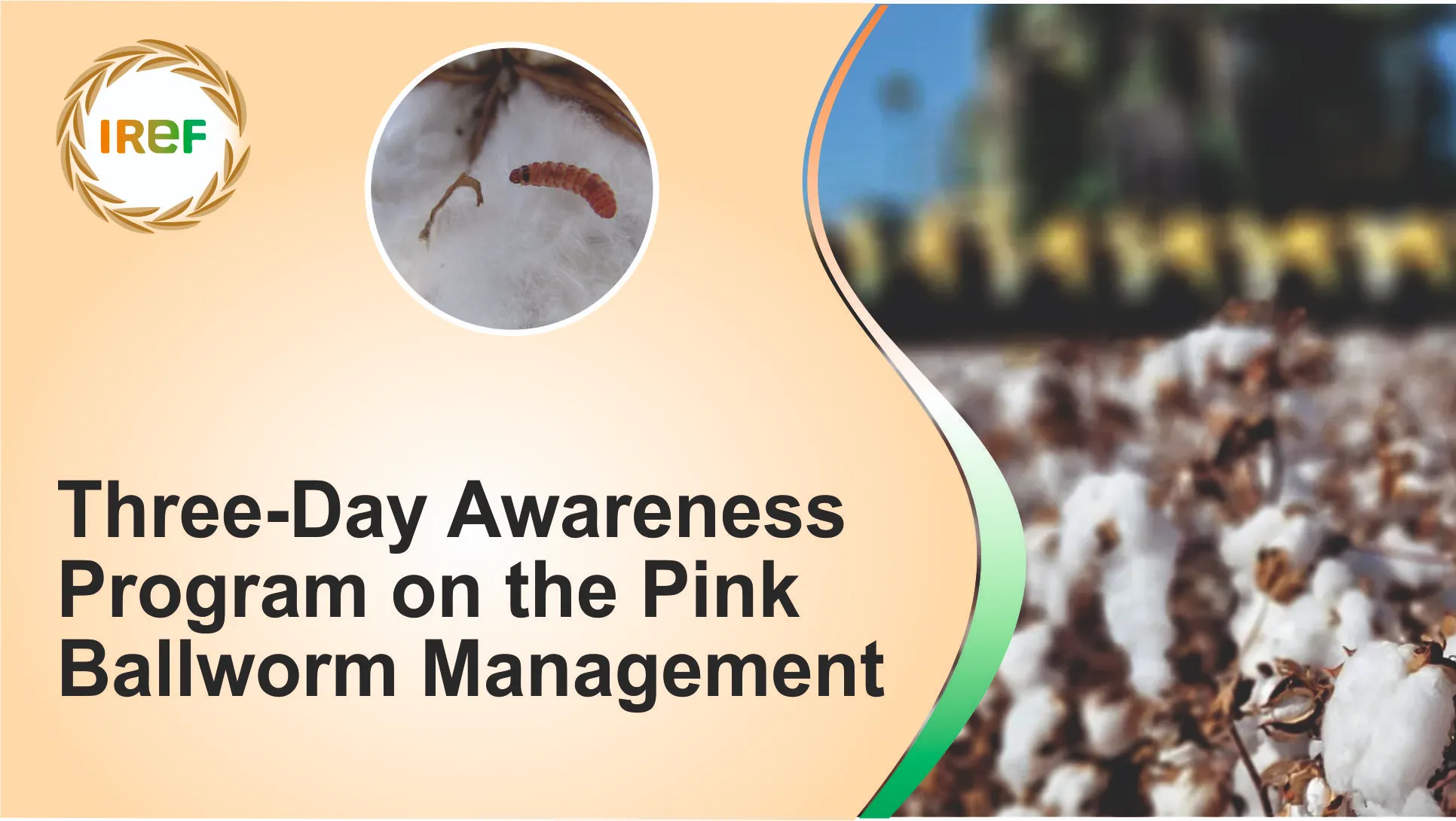
Dhanuka Agritech Ltd., in association with ICAR-Central Institute for Cotton Research (CICR), Regional Station, Sirsa, conducted a three-day awareness Program for farmers in key cotton-growing regions in North India, such as Sri Ganganagar (Rajasthan), Abohar (Punjab), and finalised in Sirsa (Haryana), Surprisingly, the event invited a slew of cotton farmers, scientists, and agricultural stakeholders with an objective to aware farmers regarding best practices for pink bollworm management and to promote sustainable agriculture hand in hand. The leading scientists from ICAR-CICR delivered in-depth technical sessions during the three-day awareness program.
Furthermore, Dr. R.G. Agarwal, Chairman Emeritus of Dhanuka Agritech, appealed to the farmers to stay careful against fake agricultural inputs. He focused on the significance of purchasing only authenticated products to safeguard the crop yield as well as farmer income. Dr. Agarwal also highlighted the urgent need for water conservation, requesting united efforts from all stakeholders to secure long-term sustainability in farming. Additionally, Dr. Rishi Kumar, Principal Scientist (Entomology) and Head (I/c), ICAR-CICR Sirsa, provided detailed information on managing pink bollworm using IPM techniques.
Dr. Amarpreet Singh, Senior Scientist (Agronomy) emphasised the role of timely sowing, appropriate plant spacing, and nutrient management in enhancing cotton resilience. Dr. P.K. Chakrabarty, Chief Scientific Advisor to Dhanuka Agritech and former ADG (Plant Protection), ICAR, informed the Way Forward for Cotton Production in the North Zone, advocating science-led solutions and stakeholder cooperation at the end of the Technical sessions.
The final day of the three-day awareness program in Sirsa, Haryana, was honoured by Chief Guest Dr. B. S. Kamboj, Vice Chancellor of Chaudhary Charan Singh Haryana Agricultural University (HAU), who applauded the joint efforts of ICAR-CICR and Dhanuka Agritech in educating and empowering cotton growers.
Lastly, the event concluded with an interactive session where farmers described their experiences and gained expert guidance on field-level challenges. The programs raised awareness about the pink bollworm and boosted the bridge between scientific knowledge and grassroots practice.
Share this article
Article Info
Read Time
2 min read
Published
29 Jul 2025
Author
Megha Bajaj
Category
News