Ethanol Exports Not A Solution For Surplus Ethanol Production: GEMA President
Ethanol Exports Not A Solution For Surplus Ethanol Production: GEMA President
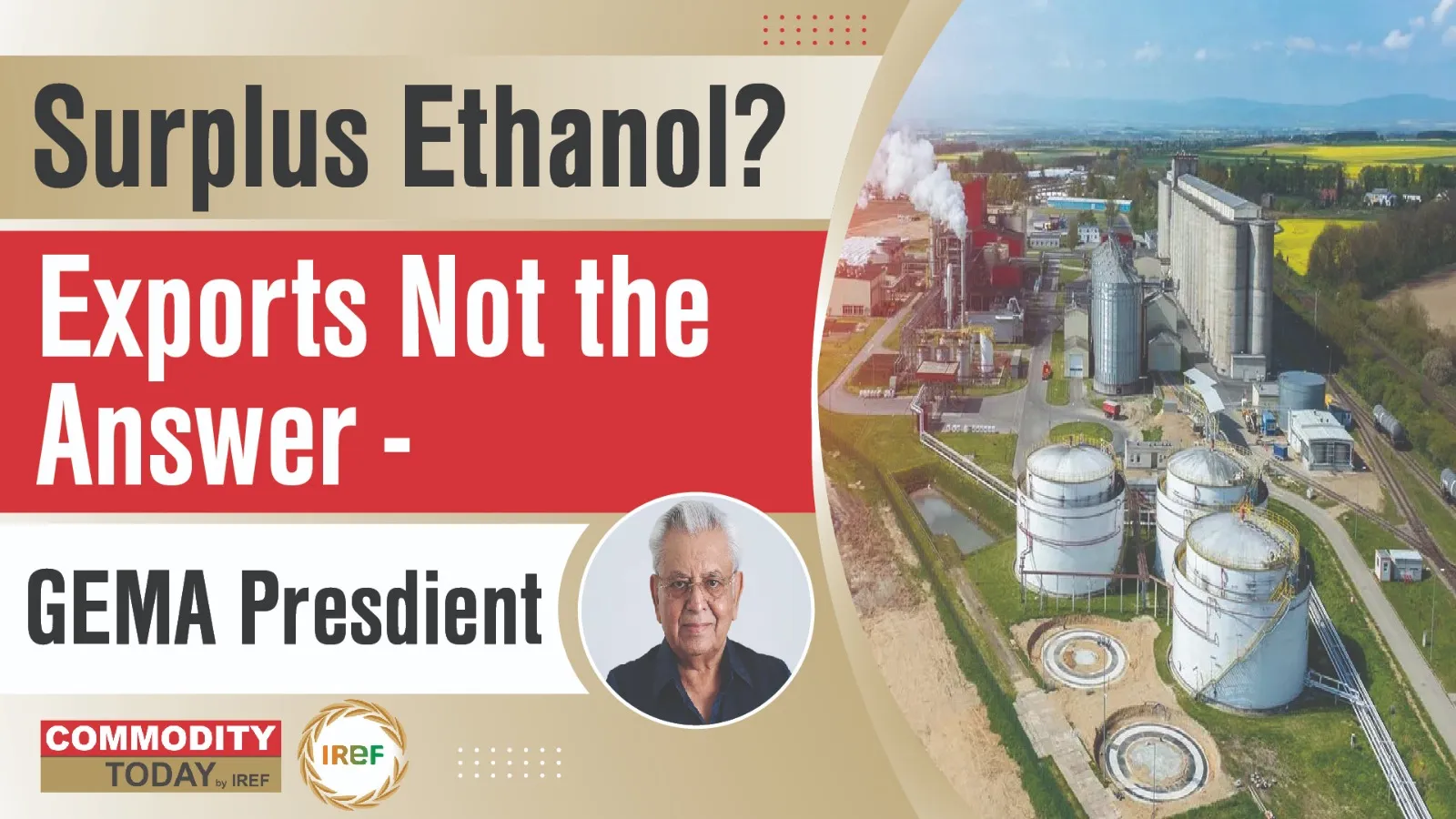
According to CK Jain, President of the Grain Ethanol Manufacturers Association (GEMA), Ethanol Exports are unlikely to offer a solution for surplus ethanol in India, who further said that domestic consumption has stagnated despite a sharp rise in production capacity. He stated that ethanol consumption has effectively stabilised at around 1,200 crore litres, even though the industry is capable of supplying much more. Although the industry is struggling with excess production, he ruled out ethanol exports as a solution for absorbing surplus ethanol. He asked: “How can we export when grain prices in India are among the highest in the world?“ We are just converters. Seventy to seventy-two per cent of the ethanol price goes to farmers.” Moreover, he clarified that whereas ethanol exports of second-generation (2G) are allowed and the production remains negligible.
He cited that they have permitted to export 2G ethanol, but it is not produced,” adding that grain-based (1G) ethanol cannot be price-competitive globally, recalling that the industry expanded rapidly after strong policy signals from the government during 2020-22. “The government kept saying ethanol, ethanol, ethanol. They said we will not stop at 20 per cent; we will go beyond that,” he said. On the back of those assurances, producers invested heavily and, importantly, expanded capacity across the country. He mentioned that there is a mismatch between policy projections and actual ethanol procurement. “If you read the NITI Aayog biofuel policy, they said consumption would be at least 1,500 crore litres by 2025,” he said. “Against that, capacity offered was about 1,770 crore litres, but the allocation was only around 1,050 crore litres.” He stated that fears related to the diversion of grains to ethanol are outdated regarding food security concerns.
Furthermore, he said diversion of grains for ethanol is limited. “It is not more than 15-20 per cent of the total grain basket,” Jain said, stressing that staples such as wheat and rice procured by FCI remain protected. Ethanol feedstock, he said, includes maize and damaged food grains. “Maize is hardly a human food. One or two per cent goes for human consumption". He stressed that ethanol has transformed maize into an industrial crop for the first time. “Earlier, maize was only a feed crop. Now it has become an industrial crop,” adding that this has direct implications for farmer incomes. He reiterated that grain-based ethanol played a significant role in attaining E20 blending but warned that without clarity on future blending targets and higher domestic absorption, the industry faces challenges forward.
Share this article
Article Info
Read Time
3 min read
Published
27 Dec 2025
Author
Megha Bajaj
Category
News